
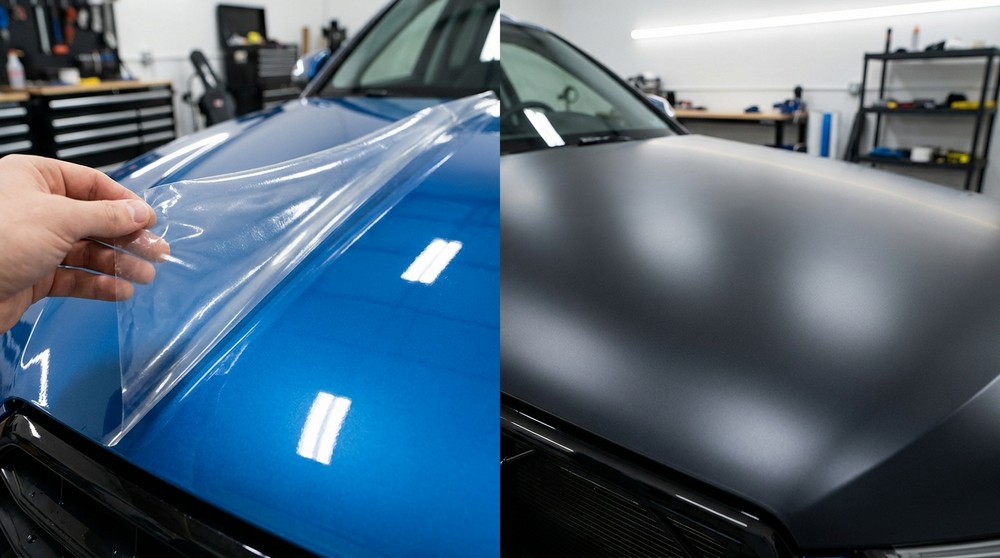
Paint protection film and vinyl wraps are both applied to vehicle surfaces, both come off clean, and both protect your car to some degree. But they are not interchangeable — and confusing the two leads to spending money on the wrong product. At Sun Diego Wraps in San Diego, we install both every week, and the first question we always ask is: what are you actually trying to do? The answer to that question determines which one you need. Here’s how to think about PPF vs. vinyl wrap in San Diego.
What Each Product Is Actually Doing to Your Car
Paint protection film — also called PPF or clear bra — is a thick, optically clear urethane film bonded directly to your painted surface. Its job is physical protection: absorbing rock chips, blocking road debris, resisting scratches, and self-healing minor surface scuffs in some premium grades. It preserves what’s underneath. You don’t see PPF on a finished car unless you’re looking for it.
Vinyl wrap is an adhesive film applied over the painted surface primarily to change appearance. It can be matte, gloss, satin, chrome, color-shift — whatever finish or color you want. It does offer a secondary layer of protection against light UV and minor abrasion, but that’s not its main function. Vinyl wrap’s job is to make the car look different. Those are two fundamentally different goals, and the products are built accordingly.
When Paint Protection Film Is the Right Call
PPF is the right choice when your priority is preserving the car’s existing paint — not changing how it looks. New car owners, luxury vehicle owners, and anyone with a factory paint job they want to protect for resale value are the core PPF customer. If you just drove a new BMW, Porsche, or Tesla off the lot and want the paint to look that good in five years, PPF is the product.
San Diego’s specific conditions make PPF especially worthwhile. The freeways — I-5, I-805, SR-163 — generate constant rock chip exposure. Coastal areas add salt air and mineral deposits. Year-round sun at San Diego’s UV index degrades unprotected clear coat faster than most US cities. Premium PPF from brands like XPEL or 3M acts as a sacrificial layer, taking that punishment so the factory paint doesn’t. Read more about the benefits of clear bra protection.
Full-front PPF packages — hood, front bumper, fenders, mirrors, and A-pillars — typically run $1,500–$3,500 at Sun Diego Wraps depending on coverage and vehicle size. Full-vehicle PPF runs $4,000–$8,000+. It’s a significant investment, but it directly preserves the car’s resale value at a rate that usually exceeds the cost of the film.
When Vinyl Wrap Is the Right Call
Vinyl wrap makes sense when appearance is the goal — a color change, a custom finish, or a branded commercial graphic. It’s also the answer for leased vehicles, where permanent modifications aren’t allowed. A vinyl wrap goes on cleanly and comes off cleanly when the lease ends, leaving the factory paint underneath untouched.
It’s also the right product for car enthusiasts who want to change colors more than once. A matte black full wrap over factory silver gives you a completely different-looking car. In three years, you can have it removed and go a different direction without touching the original paint. That flexibility has no equivalent in a traditional paint job. Get a Free Quote to discuss vinyl wrap options for your vehicle.
Side-by-Side: Cost, Durability, and Appearance
Here’s how the two products compare across the factors that matter most to San Diego car owners:
- Purpose: PPF protects existing paint. Vinyl wrap changes appearance.
- Visibility: PPF is clear and nearly invisible. Vinyl wrap is visible — that’s the point.
- Cost (full vehicle): PPF runs $4,000–$8,000+. Full vinyl wrap runs $2,000–$5,000.
- Durability: Premium PPF lasts 8–12 years. Quality vinyl wrap lasts 5–7 years.
- Rock chip protection: PPF — yes. Vinyl wrap — minimal.
- Color/finish options: PPF is clear only (or tinted PPF in some versions). Vinyl wrap has hundreds of finishes.
- Reversibility: Both come off without damaging factory paint when properly installed.
When You Should Use Both Together
This is more common than people expect, and it’s often the best outcome for a high-value vehicle. PPF goes on the high-impact areas — front bumper, hood, leading edge of the mirrors, A-pillars — where rock chips and road debris cause the most damage. Vinyl wrap then goes over the rest of the car for the color change or finish you want. The two products layer without conflicting.
A practical example: a Tesla Model Y owner wants a matte gray full wrap but also wants to protect the hood and bumper from freeway chip damage. The answer is PPF on the front end first, then vinyl over the full car — including over the PPF. When the vinyl comes off years later, the PPF is still doing its job underneath. Sun Diego Wraps handles both in-house, so this kind of combined installation is straightforward to plan and execute.
What to Know Before Choosing in San Diego
San Diego’s climate is a real factor in this decision. The UV index here is among the highest in California — clear coat on an unprotected car starts showing micro-oxidation within three to four years if it’s parked outside regularly. PPF blocks UV at the film layer and keeps the paint looking new much longer. Vinyl wrap provides a UV buffer too, but it’s a secondary benefit rather than the product’s designed function.
The salt air from coastal areas — Pacific Beach, Ocean Beach, La Jolla, Coronado — is another factor that accelerates clear coat degradation. If you live close to the coast and your car is outside most of the time, PPF on the front end is a genuinely sound investment in the vehicle’s long-term condition.
Frequently Asked Questions: PPF vs. Vinyl Wrap
Can I put vinyl wrap on top of PPF?
Yes — and it works well. PPF goes on first, then vinyl wrap goes on top. This approach protects the paint from chips while still giving you the color or finish change you want. Sun Diego Wraps does this combination regularly, particularly for new car owners who want both protection and a custom look.
Which one is better for a leased vehicle?
Vinyl wrap is generally the better fit for leased vehicles because it allows a color change or custom look while the lease is active, then comes off cleanly at return. PPF also works on leases — it actually protects the factory paint from the minor wear a lease return inspection checks for. Many leased car owners use PPF on high-risk panels for exactly that reason.
Does PPF change the look of the car?
Premium PPF is optically clear and doesn’t change the car’s appearance in any meaningful way. There are also matte PPF options that give painted surfaces a matte finish while still providing full chip protection — a popular option for vehicles where owners want both protection and a subtle finish change without a full vinyl wrap.
How do I decide which one to get first?
Start with the question of whether you’re trying to protect the car or change how it looks. If the answer is protect — especially on a newer or high-value vehicle — PPF comes first. If the answer is change the appearance on a car whose paint is already in good shape, vinyl wrap is the right starting point. A short consultation at Sun Diego Wraps will get you to the right answer for your specific vehicle and budget.
Making the Decision at Sun Diego Wraps
The PPF vs. vinyl wrap decision in San Diego doesn’t have to be complicated. Most of the time, the answer comes down to this: if you love the color your car already is and want to keep it looking that way, you need PPF. If you want the car to look different, you need vinyl wrap. If you want both, you can have both — and a lot of our customers do.
Sun Diego Wraps installs both products in-house with the same team. That matters because the products interact, and having one shop handle both means no finger-pointing if a question comes up later. Learn more about making your paint protection film last.
Ready to Get Started?
Whether you’re leaning toward PPF, vinyl wrap, or a combination of both, a quick consultation at Sun Diego Wraps will get you to the right answer for your car and your budget.
Get a Free Quote or call us at (619) 888-6062.